
Taking into account the current situation in trading and production enterprises, it is evident that in most cases the following picture appears:
- pressure from sales;
- inability to pay for purchases promptly;
- shortage of working capital every month.
Naturally, the CEOs of such businesses find it reasonable to start saving from their inventory. Everything seems clear enough; however, at the same time, precisely in this area they tend to make mistakes that will be paid off dearly afterwards.
Cuts in inventory spending at the most sensitive points

The first action taken under financial pressure is a reduction in overall inventory spending. Figures on paper improve instantly – there are fewer assets allocated to inventory, thus lower nominal risk. Nonetheless, savings will be made right away, at the expense of the best-selling goods – the ones that form the core of consumer activity in the company. It turns out that shelves are empty precisely of A-class products, and other lines remain idle in storage.
As a result, sales decline, as the customer base cannot find desired products. Moreover, the company does not receive additional funds; inventory becomes somewhat cheaper, yet the decrease in sales makes any extra working capital impossible to obtain. In short, potential income from the top-selling lines is lost.
Cheap sourcing and larger order volumes – hidden expenses
It is common practice for companies to try to find cheaper suppliers too. Cheaper purchases and extended payment periods are quite apparent benefits of such actions. Nevertheless, they usually include some extra requirements: increased order volumes, fewer delivery periods, and decreased ability to change the volume of orders.
In practice, this implies placing orders for extra units to receive discounts or enjoy free shipping. Some of them can go out, yet a good portion of the ordered goods will remain in warehouses. Should the effective demand prove to be insufficient, savings on unit price become actual losses due to tying up capital in slow-moving inventory. It is evident that the warehouse becomes full of product; its shelves are not empty, yet capital stops moving since it stays tied up by low-value goods. Meanwhile, the most popular products can lack stock since the entire budget has been spent.
Planning according to supplier requirements rather than consumer behavior
The third common practice is to schedule purchases based on the suppliers’ requirements rather than consumers’ behavior. Many businesses delay purchases and accumulate a sufficient number of lines to achieve either minimum purchase volume or reach so-called freight-free delivery. Such planning is commonly done for all goods, regardless of their sales rate, rather than some particular types.
It creates a very simple but dangerous situation. You slowly build up more and more stock of products that customers rarely buy, while at the same time you often run out of the products they buy the most. So the warehouse is full, and the total inventory value is high, but a big part of that value is sitting in slow-moving items that bring in cash very slowly.
From the customer’s point of view, the opposite is true: when they come to you, they often do not find the key, popular products they expect. The shelves are not empty, but they are full of the wrong things. The assortment feels weaker, customers lose interest, move to competitors, and sales go down – even though you are holding a lot of inventory.
Producing at full tilt despite slowing demand
For manufacturers, the scenario remains the same; the mechanics may differ. In order to utilize capacity effectively, it has become commonplace to produce at full speed despite falling sales levels. The reasoning is understandable – machines are costly, downtime is wasteful. Nonetheless, if the market is buying less of your product, running production lines at full speed just increases inventory levels. Products are transferred into inventory faster than out of it. With each additional run, more money goes into inventory. At the same time, the pressures on cash flow remain intact. This situation becomes more pressing not because of an absence of sales, but because of excess cash being locked into inventory.
Real trouble lies in money being tied up in the wrong products

Taking into consideration all of the above actions, the obvious solution arises. First of all, the problem here is not the complete lack of funds within the business. The key problem is the poor circulation of money and its accumulation in wrong products. Too many resources are being spent on the development of goods which have a very low turnover, too few on goods with a high turnover rate; purchase orders are made based on suppliers’ conditions instead of demand; customers do not see what they need and go elsewhere.
It follows from that in this situation, making any additional efforts to save on inventory would only make things worse. For that reason, the inventory should be viewed as a portfolio of investments.
On A-items and rotation, rather than margin
The simplest approach is to split your SKUs into two parts – by their value, not equally. In many cases, 80% of the turnover is provided by an 8–12% share of products – these are true A-items. B and C items make up significantly fewer euros in total but will occupy working capital if no specific actions are taken.
For your A‑items, the products that sell the most, you should try to always keep them in stock, even when money is tight. They bring in most of your sales, so they must be your first priority.
For B‑ and C‑items, products that sell less, you should be much stricter. Buy smaller quantities, or buy them only when you already have a customer order or prepayment. This helps you avoid freezing money in slow-moving stock and leaves more cash for the products that really drive your business.
You should also not look only at margin. It is usually better to sell a product with a slightly lower margin that sells quickly, than a product with a high margin that sells very slowly. Fast-moving products return your cash faster, which is healthier for your cash flow.
More frequent small orders from responsive suppliers would also contribute, as long as they are placed based on clear economic logic and sound reasoning, not only because some rule or policy says so. Instead of producing large, risky batches solely to benefit from volume discounts, the company can place well-justified smaller orders, react more promptly to real market demand, and keep its stock levels much closer to actual consumption.
Inventory management as a financial process
It is clear now that inventory management goes beyond storage issues. Every item in the inventory represents capital employed elsewhere, and each instance of inventory shortage means lost revenue. This turns inventory management into a vital financial management activity, which requires structured data on all aspects of it – current stock position in all warehouses, critical stocks that tie up capital, items prone to stockouts, and items that can be safely cut.
Such an approach cannot be implemented without proper organization and a structured decision-making system. This system should involve prioritization, ordering, and analysis of the impacts of the decisions made on the service level and financial flows.
StockM – making inventory decisions healthier
As a system that has been specially developed to perform this kind of task, StockM represents an inventory management solution designed specifically for mid-sized organizations and enterprises interested in securing their essential inventory without wasting too much capital tied to their inventory. The inventory management system incorporates Theory of Constraints concepts and utilizes dynamic inventory buffers as opposed to static min/max limits.
In essence, StockM monitors demand and supplier reliability constantly and analyzes the effectiveness of your existing inventory buffer sizes, making recommendations about potential changes. The system identifies whether there is excess inventory in any area and thus warns the user about such instances when they put customer service in danger. At the same time, it can be helpful in preventing shortages of fast-moving products.
Since there is a direct link between inventory management and working capital in StockM, the managers will be able to easily identify:
- the current product lines with the highest amount of cash,
- the product lines that bring in the largest sales and need to receive first priority,
- the products that can be reduced without affecting the customers negatively.
Companies adopting this method generally enjoy fewer stock-outs in critical products, a leaner profile in terms of slow-moving products, a more consistent procurement process with the suppliers, and faster cash flow from the inventory.
Want to know how the StockM system works and how it can help you manage inventory and cash flow in your company? – Get in touch!
Taking into account the current situation in trading and production enterprises, it is evident that in most cases the following picture appears:
- pressure from sales;
- inability to pay for purchases promptly;
- shortage of working capital every month.
Naturally, the CEOs of such businesses find it reasonable to start saving from their inventory. Everything seems clear enough; however, at the same time, precisely in this area they tend to make mistakes that will be paid off dearly afterwards.
Cuts in inventory spending at the most sensitive points
The first action taken under financial pressure is a reduction in overall inventory spending. Figures on paper improve instantly – there are fewer assets allocated to inventory, thus lower nominal risk. Nonetheless, savings will be made right away, at the expense of the best-selling goods – the ones that form the core of consumer activity in the company. It turns out that shelves are empty precisely of A-class products, and other lines remain idle in storage.
As a result, sales decline, as the customer base cannot find desired products. Moreover, the company does not receive additional funds; inventory becomes somewhat cheaper, yet the decrease in sales makes any extra working capital impossible to obtain. In short, potential income from the top-selling lines is lost.
Cheap sourcing and larger order volumes – hidden expenses
It is common practice for companies to try to find cheaper suppliers too. Cheaper purchases and extended payment periods are quite apparent benefits of such actions. Nevertheless, they usually include some extra requirements: increased order volumes, fewer delivery periods, and decreased ability to change the volume of orders.
In practice, this implies placing orders for extra units to receive discounts or enjoy free shipping. Some of them can go out, yet a good portion of the ordered goods will remain in warehouses. Should the effective demand prove to be insufficient, savings on unit price become actual losses due to tying up capital in slow-moving inventory. It is evident that the warehouse becomes full of product; its shelves are not empty, yet capital stops moving since it stays tied up by low-value goods. Meanwhile, the most popular products can lack stock since the entire budget has been spent.
Planning according to supplier requirements rather than consumer behavior
The third common practice is to schedule purchases based on the suppliers’ requirements rather than consumers’ behavior. Many businesses delay purchases and accumulate a sufficient number of lines to achieve either minimum purchase volume or reach so-called freight-free delivery. Such planning is commonly done for all goods, regardless of their sales rate, rather than some particular types.
It creates a very simple but dangerous situation. You slowly build up more and more stock of products that customers rarely buy, while at the same time you often run out of the products they buy the most. So the warehouse is full, and the total inventory value is high, but a big part of that value is sitting in slow-moving items that bring in cash very slowly.
From the customer’s point of view, the opposite is true: when they come to you, they often do not find the key, popular products they expect. The shelves are not empty, but they are full of the wrong things. The assortment feels weaker, customers lose interest, move to competitors, and sales go down – even though you are holding a lot of inventory.
Producing at full tilt despite slowing demand
For manufacturers, the scenario remains the same; the mechanics may differ. In order to utilize capacity effectively, it has become commonplace to produce at full speed despite falling sales levels. The reasoning is understandable – machines are costly, downtime is wasteful. Nonetheless, if the market is buying less of your product, running production lines at full speed just increases inventory levels. Products are transferred into inventory faster than out of it. With each additional run, more money goes into inventory. At the same time, the pressures on cash flow remain intact. This situation becomes more pressing not because of an absence of sales, but because of excess cash being locked into inventory.
Real trouble lies in money being tied up in the wrong products
Taking into consideration all of the above actions, the obvious solution arises. First of all, the problem here is not the complete lack of funds within the business. The key problem is the poor circulation of money and its accumulation in wrong products. Too many resources are being spent on the development of goods which have a very low turnover, too few on goods with a high turnover rate; purchase orders are made based on suppliers’ conditions instead of demand, customers do not see what they need and go elsewhere.
It follows from that in this situation, making any additional efforts to save on inventory would only make things worse. For that reason, the inventory should be viewed as a portfolio of investments.
On A-items and rotation, rather than margin
The simplest approach is to split your SKUs into two parts – by their value, not equally. In many cases, 80% of the turnover is provided by an 8–12% share of products – these are true A-items. B and C items make up significantly fewer euros in total but will occupy working capital if no specific actions are taken.
For your A‑items, the products that sell the most, you should try to always keep them in stock, even when money is tight. They bring in most of your sales, so they must be your first priority.
For B‑ and C‑items, products that sell less, you should be much stricter. Buy smaller quantities, or buy them only when you already have a customer order or prepayment. This helps you avoid freezing money in slow-moving stock and leaves more cash for the products that really drive your business.
You should also not look only at margin. It is usually better to sell a product with a slightly lower margin that sells quickly, than a product with a high margin that sells very slowly. Fast-moving products return your cash faster, which is healthier for your cash flow.
More frequent small orders from responsive suppliers would also contribute, as long as they are placed based on clear economic logic and sound reasoning, not only because some rule or policy says so. Instead of producing large, risky batches solely to benefit from volume discounts, the company can place well-justified smaller orders, react more promptly to real market demand, and keep its stock levels much closer to actual consumption.
Inventory management as a financial process
It is clear now that inventory management goes beyond storage issues. Every item in the inventory represents capital employed elsewhere, and each instance of inventory shortage means lost revenue. This turns inventory management into a vital financial management activity, which requires structured data on all aspects of it – current stock position in all warehouses, critical stocks that tie up capital, items prone to stockouts, and items that can be safely cut.
Such an approach cannot be implemented without proper organization and a structured decision-making system. This system should involve prioritization, ordering, and analysis of the impacts of the decisions made on the service level and financial flows.
StockM – making inventory decisions healthier
As a system that has been specially developed to perform this kind of task, StockM represents an inventory management solution designed specifically for mid-sized organizations and enterprises interested in securing their essential inventory without wasting too much capital tied to their inventory. The inventory management system incorporates Theory of Constraints concepts and utilizes dynamic inventory buffers as opposed to static min/max limits.
In essence, StockM monitors demand and supplier reliability constantly and analyzes the effectiveness of your existing inventory buffer sizes, making recommendations about potential changes. The system identifies whether there is excess inventory in any area and thus warns the user about such instances when they put customer service in danger. At the same time, it can be helpful in preventing shortages of fast-moving products.
Since there is a direct link between inventory management and working capital in StockM, the managers will be able to easily identify:
- the current product lines with the highest amount of cash,
- the product lines that bring in the largest sales and need to receive first priority,
- the products that can be reduced without affecting the customers negatively.
Companies adopting this method generally enjoy fewer stock-outs in critical products, a leaner profile in terms of slow-moving products, a more consistent procurement process with the suppliers, and faster cash flow from the inventory.
Want to know how the StockM system works and how it can help you manage inventory and cash flow in your company? – Get in touch!
Read more articles
- Where does working capital get tied up in inventory?
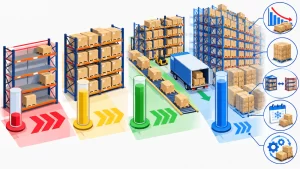 Working capital is rarely tied up in inventory because of one big, obvious mistake. More often, it builds up gradually through many smaller decisions: ordering quantities set to meet a supplier’s minimum, safety stock that is no longer needed, products that sell more slowly than before, or inventory held in one location when it is needed somewhere else.
 - Inventory and working capital: is inventory an investment for a business?
 Read more articles
 - TOC or forecasting: TOC dynamic buffer management should drive day-to-day inventory decisions
 Companies that already use demand forecasting often ask whether it can be used alongside inventory management based on TOC dynamic buffer management. It can. The key is to define clearly what each method is responsible for.
