
Working capital is rarely tied up in inventory because of one big, obvious mistake. More often, it builds up gradually through many smaller decisions: ordering quantities set to meet a supplier’s minimum, safety stock that is no longer needed, products that sell more slowly than before, or inventory held in one location when it is needed somewhere else.
While each of these actions is justifiable on its own merit, when they are combined, they can lead to an organization having greater and greater amounts of money stuck in its inventory, poor liquidity, a rising chance that its stock will be aged, and shortages of its key products.
Managing inventory well involves recognizing the exact inventory positions within SKU locations that the money is being tied up in, determining what caused the problem, and taking the necessary steps before the inventory gets devalued further.
Inventory can become the largest working-capital burden
Inventory becomes a working-capital problem when stock levels increase faster than actual demand, when replenishment parameters are not adjusted after supply conditions improve, or when products continue to be replenished even though their commercial importance is declining.
This issue is not limited to individual companies. A 2025 net working-capital study by H&Z covered 290 manufacturing companies in Germany, Austria, and Switzerland with annual revenue above EUR 50 million. The study reveals that inventory days have grown by 17% in all industries during the years 2019 to 2023. During this time frame, the days for collection of receivables and supplier days have not changed substantially. It suggests that the rise in working capital needs is due to cash being locked in inventory.
The study’s authors link this change to companies’ efforts to protect themselves against supply-chain disruption. They also emphasise that inventory optimisation has become one of the most important levers for improving liquidity. This does not mean that inventory should be reduced equally across all categories. Businesses need to identify precisely which products and locations still protect sales and operational flow, and where capital is already tied up in excess, slow-moving, or unnecessary stock.
This might have been caused by the influence of COVID-19 on the supply chain, where either the supply chain was stalled or there were major disruptions. Due to the shortage, companies placed more orders to cover for the supply chain disruption. However, inventory levels have clearly not returned to their pre-pandemic position. This makes it important to analyse what inventory consists of, which positions are tying up working capital, and how those positions can be managed more effectively.
Seven areas where inventory ties up cash
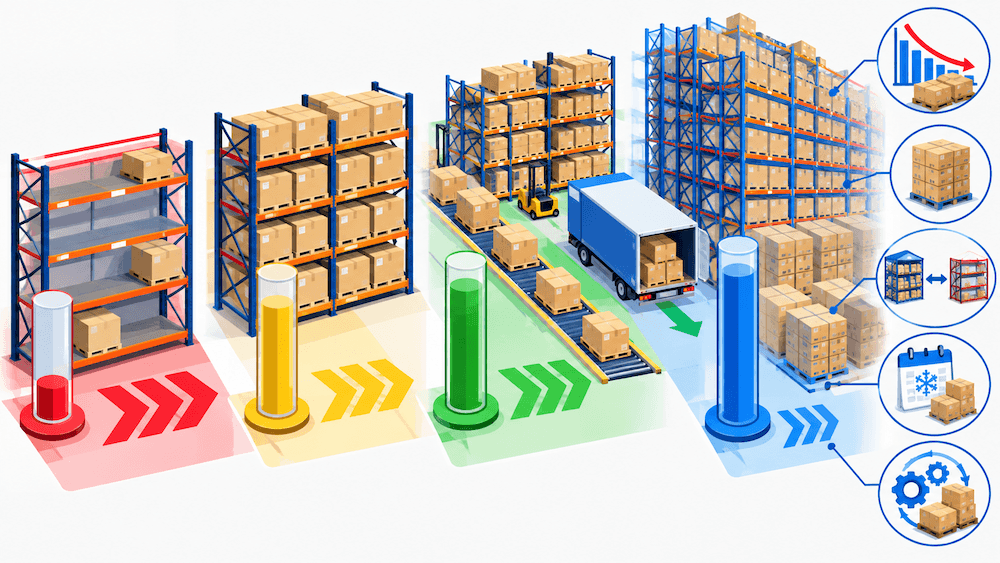
Cash becomes tied up in inventory not because of one major mistake, but because of recurring decisions that gradually stop reflecting actual demand and supply conditions. These patterns can be identified and managed by reviewing each product individually and in the context of its specific location.
1. Demand has fallen, but replenishment still goes on
The item could have been a hot seller before, but not anymore. The demand may now have switched over to some other item that is a new version or an entirely new product line.
The risk arises when replenishment continues to be based on historic consumption, particularly in min–max or forecast-driven environments. Even a product that still sells occasionally can accumulate excess inventory if it is ordered in quantities that no longer reflect expected demand.
| What it looks like? | Why cash gets tied up? | Typical action |
| Consumption is declining, but inventory remains stable or increases | Products are purchased faster than they are sold or used | Reduce future replenishment, review inventory levels, and assess pricing or product-discontinuation options |
| Days of inventory are increasing | Inventory takes longer to turn into revenue | Align replenishment with current rather than historic demand |
| The product remains active but sells only occasionally | The inventory level may be too high for its actual role | Apply replenishment logic appropriate for low or intermittent demand |
Slow-moving products do not necessarily need to be removed from the assortment. However, the investment in their inventory needs to reflect their actual commercial importance and expected consumption.
2. Inventory levels still reflect past risk
Inventory levels and safety stock are usually set for sound reasons. A business may need protection against long or unreliable lead times, variable demand, production disruption, or the risk of failing to fulfil an important customer order.
The problem begins when the original reason for holding additional inventory changes, but inventory levels and safety stock remain the same.
This can happen when:
- a supplier becomes more reliable or begins delivering more frequently;
- lead times become shorter;
- demand declines;
- the product becomes less important to the business;
- alternative supply sources become available;
- safety stock for the same demand stream is held in several locations.
In these cases, an inventory level that was once necessary can become an invisible source of excess stock.
Inventory levels should be treated as a planned investment in the availability of a specific product at a specific location. When demand or supply conditions change, the appropriate inventory level should change as well.
A 2021 simulation study, “Evaluation of Dynamic Buffer Management for Adjusting Stock Level: A Simulation-Based Approach,” found that TOC dynamic buffer management can reliably balance product availability and control of excess inventory.
3. Supplier conditions drive purchasing decisions
Many excess-inventory problems begin with purchasing terms and constraints. Companies may buy more than they currently need in order to meet a supplier’s minimum order quantity, qualify for a volume discount, fill a pallet, truck, or container, reach a free-delivery threshold, reduce the administrative workload of frequent ordering, or comply with a supplier’s delivery schedule.
A lower unit purchase price is often the main reason for placing replenishment orders. However, the cost of holding and managing excessive inventory is considered far less often.
| What it looks like? | Why cash gets tied up? | Typical action |
| Products remain in storage for a long time after large purchases | The quantity purchased exceeds near-term demand | Review order quantities in relation to expected consumption and cash-flow impact |
| A supplier discount requires a significantly larger purchase quantity | Unit-cost savings may be outweighed by tied-up cash and the risk of ageing stock | Assess the total financial impact, not only the unit price |
| Orders must fill pallets, containers, or transport capacity | Logistics efficiency creates inventory that may remain unsold for months | Negotiate delivery frequency, order terms, or consolidated replenishment |
Costs associated with a bigger purchase go beyond just the amount stated on the invoice. They encompass capital invested in the form of inventory, storage, handling, insurance, risks of becoming obsolete, markdowns, and possible write-offs.
Then there is opportunity cost. Money locked up in dead stock cannot be used for buying popular goods or anything else.
4. Inventory is held in the wrong location
A company may have sufficient inventory overall and still face shortages. This happens when stock is allocated between locations without reflecting actual demand.
One warehouse may have excess stock while another location faces shortages and lost sales. The business then experiences two problems at the same time:
- cash is tied up in stock where it is not needed;
- sales may be lost where the product is unavailable.
This is one of the clearest reasons why total inventory value alone is not enough for effective inventory management.
Inventory at the proper levels can be evaluated not just at the corporate level but must be looked into at the SKU or store level. The item can be vital in one branch, store, warehouse, or region but not in other places.
In such cases, companies end up purchasing extra inventory to resolve a problem in a specific location when the same item is present in other locations of the company’s network.
The outcome is usually the same; there is an increase in total inventory, increased working capital, and no increase in availability levels.
5. Temporary inventory becomes permanent
Seasonal campaigns, promotions, tenders, customer projects, and one-off commercial opportunities often justify building inventory in advance. This can be a sound decision when demand is known and stock is required before regular replenishment can respond.
However, once the event ends, the role of that inventory changes.
Products left after a promotion should not continue to be replenished based on the same logic or on sales from the previous period. Inventory accumulated for a customer project should be reviewed once the project has ended. Seasonal products should be reassessed after the selling season is over.
If this does not happen, the original reason for holding the inventory disappears while the stock remains.
| What it looks like? | Why cash gets tied up | Typical action |
| Inventory remains after a promotion or season ends | The original demand driver no longer exists | Stop automatic replenishment and create an inventory exit plan |
| Inventory was reserved for a project that has ended or been delayed | The product’s original purpose is no longer clear | Transfer, return, discount, or repurpose the stock where possible |
| A product is replaced by a newer version | Demand declines and the risk of obsolescence increases | Reduce replenishment early and plan a controlled product phase-out |
Temporary inventory needs to remain temporary. A review after a promotion, season, tender, or project helps ensure that stock does not continue consuming working capital after its commercial purpose has disappeared.
6. Static parameters continue to generate inventory
Inventory systems operate through replenishment parameters: reorder points, minimum and maximum levels, safety stock, lead times, order quantities, and replenishment frequency.
These parameters may be correct when they are set. However, changes in demand, product lifecycle, supplier reliability, or customer behaviour can make the same settings continue to generate unnecessary stock.
| What it looks like? | Why cash gets tied up? | Typical action |
| Inventory grows while demand declines | Replenishment settings are based on outdated assumptions | Review inventory levels and replenishment rules using current consumption |
| The same replenishment rule is applied to very different products | Decisions do not reflect different demand patterns or commercial importance | Segment products and apply suitable replenishment policies |
| Teams review a high number of products manually | Important deviations can be overlooked or addressed too late | Use a structured, data-driven review process that focuses on exceptions |
Static parameters are not inherently wrong. They become a problem when they are not reviewed as operating conditions change.
7. Non-moving inventory is identified but not actively resolved
Nonmoving inventory is one of the most visible instances of blocked working capital. It is not difficult to spot in financial statements; however, determining what needs to be done about it is a more challenging task.
Some possible reasons for nonmoving inventory include discontinuance of a product line, completion of projects, promotion failure, returned items, changed specifications, spoilage, and over-purchasing. The worth of non-moving inventory tends to fall over time.
| What it looks like? | Why cash gets tied up? | Typical action |
| No sales or consumption for an extended period | Cash remains tied up without a realistic opportunity to generate revenue or use the product | Stop replenishment and assign a specific inventory exit action |
| Inventory is ageing and the expected selling price is declining | The company may recover less than it originally invested | Apply pricing, bundling, transfer, return, or disposal actions early |
| The same non-moving products repeatedly appear in reports | The issue is visible, but decisions are not being implemented | Assign ownership, deadlines, and clear action rules |
The earlier a company acts, the more options it has. Stock may still be transferable to another location, sellable through another channel, suitable for a targeted discount, returnable to a supplier, or usable in a different application.
Waiting too long reduces these options and increases the likelihood of write-offs.
How to identify where working capital is tied up?
There is no need for manual and continuous monitoring of every single product. Once the criteria for replenishment are set up, the efforts of the team will be focused only on the exceptions: stock-out risk, excessive inventory, decreasing demand, urgent orders, lead time changes, or inappropriate allocation of inventory among sites.
| Inventory signal | Likely issue | Working-capital impact | Required decision |
| High inventory value with low or declining consumption | Slow-moving or non-moving inventory | Cash is tied up and the risk of ageing and obsolescence increases | Reduce or stop replenishment; create a transfer, sales, return, or product-discontinuation plan |
| Frequent shortages despite high total inventory value | Poor allocation or unsuitable SKU-location buffers | Lost sales despite a large inventory investment | Review buffers, inventory allocation, and transfer options |
| Repeated urgent orders or expensive transport | Buffer too low or unreliable lead time | Higher costs and unstable customer service | Increase the buffer where justified; review supplier reliability |
| High inventory after a promotion, season, or project | Temporary demand has ended | Inventory has lost its original commercial purpose | Stop replenishment and implement an exit plan |
| Large purchases followed by long holding periods | Supplier terms determine the order quantity | Unit-price savings may be lower than the cost of tied-up cash | Review minimum order quantities, delivery frequency, and the overall financial impact |
| Inventory grows even though sales do not increase | Static replenishment parameters | Inventory investment no longer reflects actual demand | Adjust replenishment rules and monitor the outcome |
The cost of waiting
- Trapped inventory not only impacts cash flow, but it may also reduce the bottom line, pose liquidity problems, and complicate decision making.
- The financial effect generally comes into being through four paths:
- Reduced liquidity. The money will be frozen within the inventory and won’t be available for payments to vendors, procurement of popular goods, or business expansion.
- Increased holding cost. Warehouse storage, handling, insurance, administrative cost and other carrying costs keep rising until the goods are sold.
- Reduced recoverable value. The aged stock may have to be marked down, returned, grouped together with others, or even scrapped.
- Opportunity cost grows. Cash invested in low-value inventory cannot be used for products or actions that would create a higher return.
A shared management process
Working capital tied up in inventory is not only a finance issue. It is shaped by decisions made across finance, purchasing, sales, supply, operations, and warehouse management.
| Team | Contribution to inventory decisions |
| Finance | Evaluates cash tied up in inventory, financing costs, cash flow, and write-off risk |
| Purchasing | Evaluates supplier terms, minimum order quantities, lead times, delivery frequency, and reliability |
| Sales | Identifies customer commitments, commercial priorities, promotions, changes in demand, and product substitutions |
| Supply and operations teams | Assess product availability, warehouse capacity, production requirements, replenishment performance, and order fulfilment |
Inventory analysis should focus on specific inventory positions and recurring patterns that require a clear decision.
For example, a slow-moving product may require a purchasing decision to stop replenishment, a sales decision on pricing or promotion, a supply decision to transfer the stock, and a finance assessment of potential write-off risk. If these decisions are not connected, products often remain in the warehouse longer than necessary.
How StockM supports effective inventory and working-capital management?
StockM has been designed so that inventory management is not limited to periodic reviews of excess or non-moving stock. It helps companies continuously maintain inventory levels that reflect the real need for a specific product at a specific location.
Each product and each storage facility is assigned a stock buffer in StockM. The buffer is constantly updated depending on the real usage of products and variations in demand. In case of decreasing demand for a product, the suggested buffer becomes smaller as well. This helps avoid the situation when businesses order their stock based on outdated information after the season, campaign, etc.
The products are replenished regularly following the supply schedule. Regular replenishment makes it possible to maintain lower inventory levels naturally while keeping the most important products available. This differs from forecast-based or min–max approaches, where products are often ordered in larger quantities to replenish stock up to a predefined maximum level.
Every day, the system provides employees with clear priorities: which orders, replenishment actions, or inventory situations need to be addressed first. Instead of reviewing all products equally, the team can focus on the positions where action will have the greatest immediate impact on sales, availability, or cash tied up in inventory.
StockM also highlights situations where actual demand differs significantly from available inventory. This may indicate that an important product is approaching a shortage, that the buffer is no longer sufficient because demand has changed, or that inventory remains too high compared with actual consumption. They will be spotted earlier, allowing the firm to take action even before lost sales happen or even before extra cash is spent.
Since StockM automates most of these routine replenishment and inventory management activities, the staff will get enough time for other activities that may enhance inventory management. These activities include negotiation of orders in quantity, frequency, and commercial terms with suppliers, identification of alternative suppliers, evaluation of new products, decision-making about prices, and transfer of inventory between sites.
All these activities are undertaken with one aim in mind: keeping the amount of inventory that is really required by the company. This protects the availability of key products and supports sales while avoiding unnecessary working capital being tied up in excess stock.
Inventory management needs to become a continuous decision-making process
Excess inventory typically develops gradually. Demand changes, supply conditions evolve, a season or promotion ends, or a product’s commercial role changes – while replenishment rules and purchasing decisions remain the same.
Inventory management, therefore, is an approach to treating inventory as a constantly evolving investment. For each product at each location, it is crucial to determine its importance, as it either participates in the sales stream, is needed to ensure production flow, covers supply risks, or has become commercially useless.
This method will help the company avoid both extremes. The first one is having too much inventory, which results in low liquidity and the danger of incurring additional costs, aging, and writing off the inventory. The other extreme is having too little inventory of necessary products, which leads to stockouts, loss of sales opportunities, rush orders, and dissatisfied customers.
StockM makes this principle work every day, as it makes necessary adjustments to inventory buffers to actual demand, regularly replenishes products, shows the most significant deviations, and directs employee attention where it is really needed.
Working capital is rarely tied up in inventory because of one big, obvious mistake. More often, it builds up gradually through many smaller decisions: ordering quantities set to meet a supplier’s minimum, safety stock that is no longer needed, products that sell more slowly than before, or inventory held in one location when it is needed somewhere else.
While each of these actions is justifiable on its own merit, when they are combined, they can lead to an organization having greater and greater amounts of money stuck in its inventory, poor liquidity, a rising chance that its stock will be aged, and shortages of its key products.
Managing inventory well involves recognizing the exact inventory positions within SKU locations that the money is being tied up in, determining what caused the problem, and taking the necessary steps before the inventory gets devalued further.
Inventory can become the largest working-capital burden
Inventory becomes a working-capital problem when stock levels increase faster than actual demand, when replenishment parameters are not adjusted after supply conditions improve, or when products continue to be replenished even though their commercial importance is declining.
This issue is not limited to individual companies. A 2025 net working-capital study by H&Z covered 290 manufacturing companies in Germany, Austria, and Switzerland with annual revenue above EUR 50 million. The study reveals that inventory days have grown by 17% in all industries during the years 2019 to 2023. During this time frame, the days for collection of receivables and supplier days have not changed substantially. It suggests that the rise in working capital needs is due to cash being locked in inventory.
The study’s authors link this change to companies’ efforts to protect themselves against supply-chain disruption. They also emphasise that inventory optimisation has become one of the most important levers for improving liquidity. This does not mean that inventory should be reduced equally across all categories. Businesses need to identify precisely which products and locations still protect sales and operational flow, and where capital is already tied up in excess, slow-moving, or unnecessary stock.
This might have been caused by the influence of COVID-19 on the supply chain, where either the supply chain was stalled or there were major disruptions. Due to the shortage, companies placed more orders to cover for the supply chain disruption. However, inventory levels have clearly not returned to their pre-pandemic position. This makes it important to analyse what inventory consists of, which positions are tying up working capital, and how those positions can be managed more effectively.
Seven areas where inventory ties up cash
Cash becomes tied up in inventory not because of one major mistake, but because of recurring decisions that gradually stop reflecting actual demand and supply conditions. These patterns can be identified and managed by reviewing each product individually and in the context of its specific location.
1. Demand has fallen, but replenishment still goes on
The item could have been a hot seller before, but not anymore. The demand may now have switched over to some other item that is a new version or an entirely new product line.
The risk arises when replenishment continues to be based on historic consumption, particularly in min–max or forecast-driven environments. Even a product that still sells occasionally can accumulate excess inventory if it is ordered in quantities that no longer reflect expected demand.
| What it looks like? | Why cash gets tied up? | Typical action |
|---|---|---|
| Consumption is declining, but inventory remains stable or increases | Products are purchased faster than they are sold or used | Reduce future replenishment, review inventory levels, and assess pricing or product-discontinuation options |
| Days of inventory are increasing | Inventory takes longer to turn into revenue | Align replenishment with current rather than historic demand |
| The product remains active but sells only occasionally | The inventory level may be too high for its actual role | Apply replenishment logic appropriate for low or intermittent demand |
Slow-moving products do not necessarily need to be removed from the assortment. However, the investment in their inventory needs to reflect their actual commercial importance and expected consumption.
2. Inventory levels still reflect past risk
Inventory levels and safety stock are usually set for sound reasons. A business may need protection against long or unreliable lead times, variable demand, production disruption, or the risk of failing to fulfil an important customer order.
The problem begins when the original reason for holding additional inventory changes, but inventory levels and safety stock remain the same.
This can happen when:
- a supplier becomes more reliable or begins delivering more frequently;
- lead times become shorter;
- demand declines;
- the product becomes less important to the business;
- alternative supply sources become available;
- safety stock for the same demand stream is held in several locations.
In these cases, an inventory level that was once necessary can become an invisible source of excess stock.
Inventory levels should be treated as a planned investment in the availability of a specific product at a specific location. When demand or supply conditions change, the appropriate inventory level should change as well.
A 2021 simulation study, “Evaluation of Dynamic Buffer Management for Adjusting Stock Level: A Simulation-Based Approach,” found that TOC dynamic buffer management can reliably balance product availability and control of excess inventory.
3. Supplier conditions drive purchasing decisions
Many excess-inventory problems begin with purchasing terms and constraints. Companies may buy more than they currently need in order to meet a supplier’s minimum order quantity, qualify for a volume discount, fill a pallet, truck, or container, reach a free-delivery threshold, reduce the administrative workload of frequent ordering, or comply with a supplier’s delivery schedule.
A lower unit purchase price is often the main reason for placing replenishment orders. However, the cost of holding and managing excessive inventory is considered far less often.
| What it looks like? | Why cash gets tied up? | Typical action |
|---|---|---|
| Products remain in storage for a long time after large purchases | The quantity purchased exceeds near-term demand | Review order quantities in relation to expected consumption and cash-flow impact. |
| A supplier discount requires a significantly larger purchase quantity | Unit-cost savings may be outweighed by tied-up cash and the risk of ageing stock | Assess the total financial impact, not only the unit price. |
| Orders must fill pallets, containers, or transport capacity | Logistics efficiency creates inventory that may remain unsold for months | Negotiate delivery frequency, order terms, or consolidated replenishment. |
Costs associated with a bigger purchase go beyond just the amount stated on the invoice. They encompass capital invested in the form of inventory, storage, handling, insurance, risks of becoming obsolete, markdowns, and possible write-offs.
Then there is opportunity cost. Money locked up in dead stock cannot be used for buying popular goods or anything else.
4. Inventory is held in the wrong location
A company may have sufficient inventory overall and still face shortages. This happens when stock is allocated between locations without reflecting actual demand.
One warehouse may have excess stock while another location faces shortages and lost sales. The business then experiences two problems at the same time:
- cash is tied up in stock where it is not needed;
- sales may be lost where the product is unavailable.
This is one of the clearest reasons why total inventory value alone is not enough for effective inventory management.
Inventory at the proper levels can be evaluated not just at the corporate level but must be looked into at the SKU or store level. The item can be vital in one branch, store, warehouse, or region but not in other places.
In such cases, companies end up purchasing extra inventory to resolve a problem in a specific location when the same item is present in other locations of the company’s network.
The outcome is usually the same; there is an increase in total inventory, increased working capital, and no increase in availability levels.
5. Temporary inventory becomes permanent
Seasonal campaigns, promotions, tenders, customer projects, and one-off commercial opportunities often justify building inventory in advance. This can be a sound decision when demand is known, and stock is required before regular replenishment can respond.
However, once the event ends, the role of that inventory changes.
Products left after a promotion should not continue to be replenished based on the same logic or on sales from the previous period. Inventory accumulated for a customer project should be reviewed once the project has ended. Seasonal products should be reassessed after the selling season is over.
If this does not happen, the original reason for holding the inventory disappears while the stock remains.
| What it looks like? | Why cash gets tied up? | Typical action |
|---|---|---|
| Inventory remains after a promotion or season ends | The original demand driver no longer exists | Stop automatic replenishment and create an inventory exit plan |
| Inventory was reserved for a project that has ended or been delayed | The product’s original purpose is no longer clear | Transfer, return, discount, or repurpose the stock where possible |
| A product is replaced by a newer version | Demand declines and the risk of obsolescence increases | Reduce replenishment early and plan a controlled product phase-out |
Temporary inventory needs to remain temporary. A review after a promotion, season, tender, or project helps ensure that stock does not continue consuming working capital after its commercial purpose has disappeared.
6. Static parameters continue to generate inventory
Inventory systems operate through replenishment parameters: reorder points, minimum and maximum levels, safety stock, lead times, order quantities, and replenishment frequency.
These parameters may be correct when they are set. However, changes in demand, product lifecycle, supplier reliability, or customer behaviour can make the same settings continue to generate unnecessary stock.
| What it looks like? | Why cash gets tied up? | Typical action |
|---|---|---|
| Inventory grows while demand declines | Replenishment settings are based on outdated assumptions | Review inventory levels and replenishment rules using current consumption |
| The same replenishment rule is applied to very different products | Decisions do not reflect different demand patterns or commercial importance | Segment products and apply suitable replenishment policies |
| Teams review a high number of products manually | Important deviations can be overlooked or addressed too late | Use a structured, data-driven review process that focuses on exceptions |
Static parameters are not inherently wrong. They become a problem when they are not reviewed as operating conditions change.
7. Non-moving inventory is identified but not actively resolved
Nonmoving inventory is one of the most visible instances of blocked working capital. It is not difficult to spot in financial statements; however, determining what needs to be done about it is a more challenging task.
Some possible reasons for nonmoving inventory include discontinuance of a product line, completion of projects, promotion failure, returned items, changed specifications, spoilage, and over-purchasing. The worth of non-moving inventory tends to fall over time.
| What it looks like? | Why cash gets tied up? | Typical action |
|---|---|---|
| No sales or consumption for an extended period | Cash remains tied up without a realistic opportunity to generate revenue or use the product | Stop replenishment and assign a specific inventory exit action |
| Inventory is ageing and the expected selling price is declining | The company may recover less than it originally invested | Apply pricing, bundling, transfer, return, or disposal actions early |
| The same non-moving products repeatedly appear in reports | The issue is visible, but decisions are not being implemented | Assign ownership, deadlines, and clear action rules |
The earlier a company acts, the more options it has. Stock may still be transferable to another location, sellable through another channel, suitable for a targeted discount, returnable to a supplier, or usable in a different application.
Waiting too long reduces these options and increases the likelihood of write-offs.
How to identify where working capital is tied up?
There is no need for manual and continuous monitoring of every single product. Once the criteria for replenishment are set up, the efforts of the team will be focused only on the exceptions: stock-out risk, excessive inventory, decreasing demand, urgent orders, lead time changes, or inappropriate allocation of inventory among sites.
| Inventory signal | Likely issue | Working-capital impact | Required decision |
|---|---|---|---|
| High inventory value with low or declining consumption | Slow-moving or non-moving inventory | Cash is tied up and the risk of ageing and obsolescence increases | Reduce or stop replenishment; create a transfer, sales, return, or product-discontinuation plan |
| Frequent shortages despite high total inventory value | Poor allocation or unsuitable SKU-location buffers | Lost sales despite a large inventory investment | Review buffers, inventory allocation, and transfer options |
| Repeated urgent orders or expensive transport | Buffer too low or unreliable lead time | Higher costs and unstable customer service | Increase the buffer where justified; review supplier reliability |
| High inventory after a promotion, season, or project | Temporary demand has ended | Inventory has lost its original commercial purpose | Stop replenishment and implement an exit plan |
| Large purchases followed by long holding periods | Supplier terms determine the order quantity | Unit-price savings may be lower than the cost of tied-up cash | Review minimum order quantities, delivery frequency, and the overall financial impact |
| Inventory grows even though sales do not increase | Static replenishment parameters | Inventory investment no longer reflects actual demand | Adjust replenishment rules and monitor the outcome |
The cost of waiting
- Trapped inventory not only impacts cash flow, but it may also reduce the bottom line, pose liquidity problems, and complicate decision-making.
- The financial effect generally comes into being through four paths:
- Reduced liquidity. The money will be frozen within the inventory and won’t be available for payments to vendors, procurement of popular goods, or business expansion.
- Increased holding cost. Warehouse storage, handling, insurance, administrative costs, and other carrying costs keep rising until the goods are sold.
- Reduced recoverable value. The aged stock may have to be marked down, returned, grouped together with others, or even scrapped.
- Opportunity cost grows. Cash invested in low-value inventory cannot be used for products or actions that would create a higher return.
A shared management process
Working capital tied up in inventory is not only a finance issue. It is shaped by decisions made across finance, purchasing, sales, supply, operations, and warehouse management.
| Team | Contribution to inventory decisions |
|---|---|
| Finance | Evaluates cash tied up in inventory, financing costs, cash flow, and write-off risk. |
| Purchasing | Evaluates supplier terms, minimum order quantities, lead times, delivery frequency, and reliability. |
| Sales | Identifies customer commitments, commercial priorities, promotions, changes in demand, and product substitutions. |
| Supply and operations teams | Assess product availability, warehouse capacity, production requirements, replenishment performance, and order fulfilment. |
Inventory analysis should focus on specific inventory positions and recurring patterns that require a clear decision.
For example, a slow-moving product may require a purchasing decision to stop replenishment, a sales decision on pricing or promotion, a supply decision to transfer the stock, and a finance assessment of potential write-off risk. If these decisions are not connected, products often remain in the warehouse longer than necessary.
How StockM supports effective inventory and working-capital management?
StockM has been designed so that inventory management is not limited to periodic reviews of excess or non-moving stock. It helps companies continuously maintain inventory levels that reflect the real need for a specific product at a specific location.
Each product and each storage facility is assigned a stock buffer in StockM. The buffer is constantly updated depending on the real usage of products and variations in demand. In case of decreasing demand for a product, the suggested buffer becomes smaller as well. This helps avoid the situation when businesses order their stock based on outdated information after the season, campaign, etc.
The products are replenished regularly following the supply schedule. Regular replenishment makes it possible to maintain lower inventory levels naturally while keeping the most important products available. This differs from forecast-based or min–max approaches, where products are often ordered in larger quantities to replenish stock up to a predefined maximum level.
Every day, the system provides employees with clear priorities: which orders, replenishment actions, or inventory situations need to be addressed first. Instead of reviewing all products equally, the team can focus on the positions where action will have the greatest immediate impact on sales, availability, or cash tied up in inventory.
StockM also highlights situations where actual demand differs significantly from available inventory. This may indicate that an important product is approaching a shortage, that the buffer is no longer sufficient because demand has changed, or that inventory remains too high compared with actual consumption. They will be spotted earlier, allowing the firm to take action even before lost sales happen or even before extra cash is spent.
Since StockM automates most of these routine replenishment and inventory management activities, the staff will get enough time for other activities that may enhance inventory management. These activities include negotiation of orders in quantity, frequency, and commercial terms with suppliers, identification of alternative suppliers, evaluation of new products, decision-making about prices, and transfer of inventory between sites.
All these activities are undertaken with one aim in mind: keeping the amount of inventory that is really required by the company. This protects the availability of key products and supports sales while avoiding unnecessary working capital being tied up in excess stock.
Inventory management needs to become a continuous decision-making process
Excess inventory typically develops gradually. Demand changes, supply conditions evolve, a season or promotion ends, or a product’s commercial role changes – while replenishment rules and purchasing decisions remain the same.
Inventory management, therefore, is an approach to treating inventory as a constantly evolving investment. For each product at each location, it is crucial to determine its importance, as it either participates in the sales stream, is needed to ensure production flow, covers supply risks, or has become commercially useless.
This method will help the company avoid both extremes. The first one is having too much inventory, which results in low liquidity and the danger of incurring additional costs, aging, and writing off the inventory. The other extreme is having too little inventory of necessary products, which leads to stockouts, loss of sales opportunities, rush orders, and dissatisfied customers.
StockM makes this principle work every day, as it makes necessary adjustments to inventory buffers to actual demand, regularly replenishes products, shows the most significant deviations, and directs employee attention where it is really needed.
Read more articles
- Where does working capital get tied up in inventory?
 Working capital is rarely tied up in inventory because of one big, obvious mistake. More often, it builds up gradually through many smaller decisions: ordering quantities set to meet a supplier’s minimum, safety stock that is no longer needed, products that sell more slowly than before, or inventory held in one location when it is needed somewhere else.
 - Inventory and working capital: is inventory an investment for a business?
 Read more articles
 - TOC or forecasting: TOC dynamic buffer management should drive day-to-day inventory decisions
 Companies that already use demand forecasting often ask whether it can be used alongside inventory management based on TOC dynamic buffer management. It can. The key is to define clearly what each method is responsible for.
